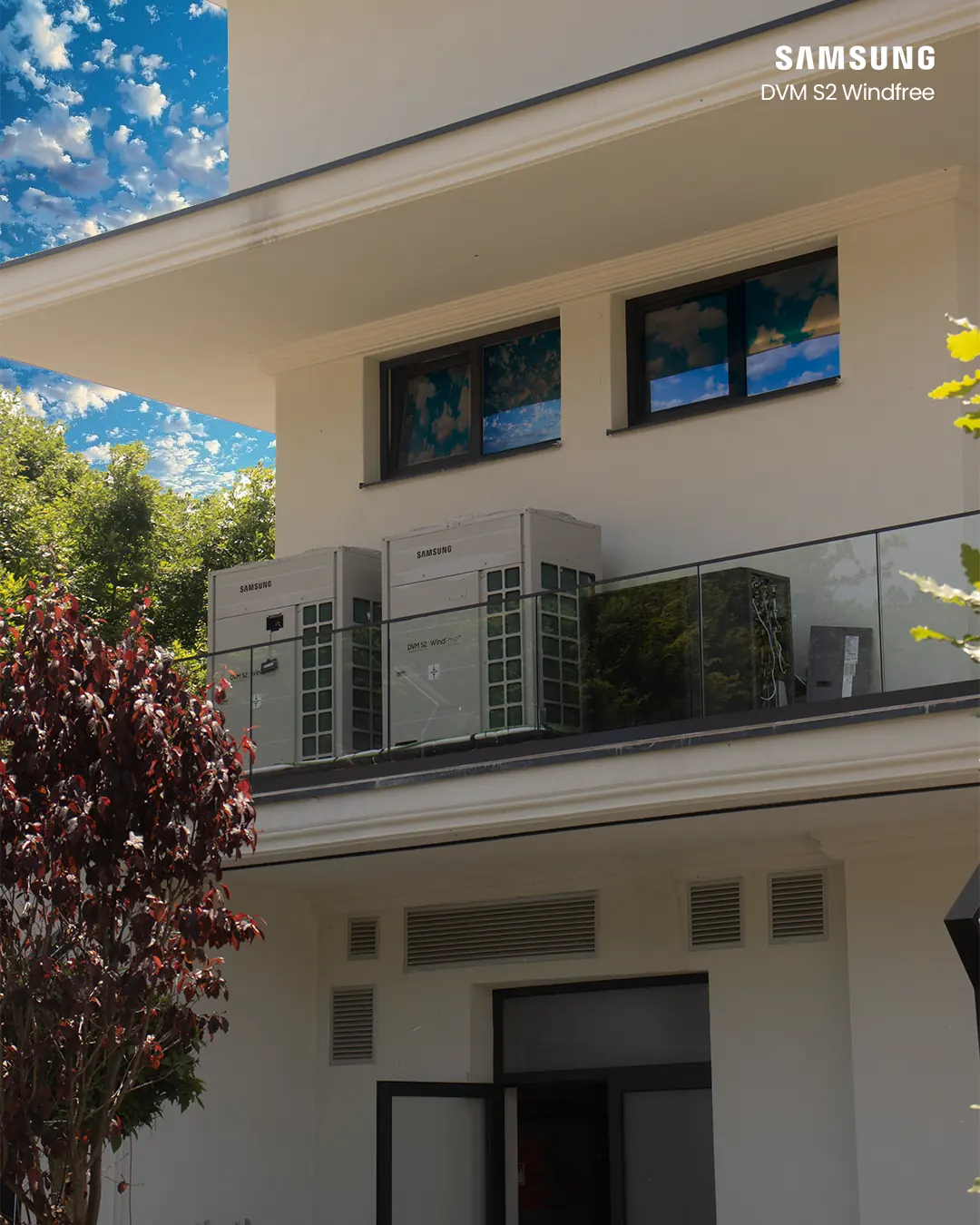
A hotel, office or shop can have rooms with different needs on the same day. VRF is a way to connect several indoor units to one shared system and adapt operation to each need.
Values from the Samsung DVM S2 datasheet (64 units) and Samsung HVAC (722 ft ≈ 220 m, −22°F = −30°C). Exact limits depend on the model and configuration.
What is a VRF system?
VRF stands for Variable Refrigerant Flow. The system adjusts how much refrigerant flows to the indoor units according to demand. It can heat and cool, depending on the configuration and the project.
How does it work?
One or more outdoor units connect to indoor units through refrigerant pipes. Indoor units can be, for example, ceiling cassettes, ducted units or wall units. The choice depends on the floor plan, how rooms are used and the project’s requirements.
From the outdoor unit to the building’s zones.
A concept view of a VRF system.
Simplified diagram; equipment and control vary by project.
One system on the roof, different zones on every floor.
The outdoor units connect to a refrigerant riser. On each floor, branches and MCU boxes take refrigerant to indoor units that suit each space.
Illustrative sketch. The number of units, branches, pipe sizes and MCU positions are set with Samsung’s design software.
Heat Pump or Heat Recovery?
A two-pipe Heat Pump configuration usually heats or cools the whole system at one time. A Heat Recovery configuration can heat and cool different zones at the same time, when the system is designed and equipped for it. The right choice depends on how the building is used.
Two pipes, or three pipes with MCUs.
With Heat Recovery, heat removed from rooms being cooled can be used for rooms being heated, which makes sense for hotels and buildings with facades facing different ways.
Samsung DVM S2
Samsung offers DVM S2 in Heat Pump and Heat Recovery versions. Specifications, capacities and the number of connectable units vary by model; they are set during design. See Samsung’s DVM S2 Heat Recovery datasheet ↗
| Configurations | Heat Pump (2 pipes) and Heat Recovery (3 pipes with MCUs) |
|---|---|
| Indoor units | up to 64 on one system |
| Combining outdoor units | several modules together; e.g. 88 HP with four units (Heat Pump) |
| Pipe length | up to ~220 m equivalent; up to ~110 m height between the outdoor unit and the furthest unit |
| Height between indoor units | up to ~40 m with Heat Recovery, ~50 m with Heat Pump |
| Outdoor temperature | from 50°C down to −30°C |
Sources: Samsung DVM S2 datasheet, DVM S2 Heat Recovery and Samsung HVAC (values in feet converted to metres). For a project in Kosovo, the European model’s data is used.

Which indoor units can be used?
VRF can be combined with various compatible units. The choice affects how air is distributed, ceiling space, appearance and access for maintenance.
Ceiling cassette
Fits into a suspended ceiling and spreads air across the space. It can suit offices, shops and restaurants.